
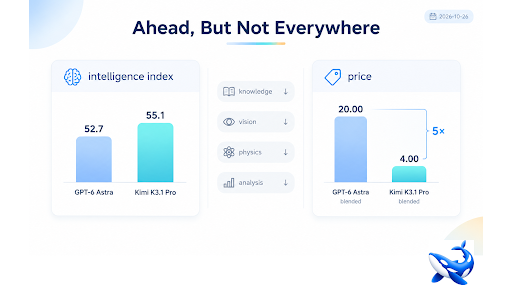
Kimi K3.1 Pro scores 55.09 on the independent index. GPT-6 Astra scores 52.67. That is a 2.42-point Kimi lead — and Astra’s blended 3:1 price is $20.00 per million against $4.00, five times as much [INDEPENDENT, index v4.3.2, 26 October]. The OrcaRouter card for Kimi 3.1 Pro carries the score and the $2.00/$10.00 rate card that produces the $4.00 blend, passed through at list, and the comparison looks like a rout until you open the component rows.
Then it stops looking like a rout. Astra is ahead on knowledge, vision, physics research and agentic analysis — four categories that cover a large share of enterprise work — while losing the composite, terminal work and long-context recall. Which model is better depends entirely on which of those you are buying.
The composite and the price
| Kimi K3.1 Pro | GPT-6 Astra | Winner | |
| AA Intelligence Index | 55.09 | 52.67 | Kimi +2.42 |
| Input / output per 1M | $2.00 / $10.00 | $10.00 / $50.00 | Kimi, 5× |
| Cache read per 1M | $0.20 | $1.00 | Kimi, 5× |
| Blended 3:1 | $4.00 | $20.00 | Kimi, 5× |
| Output speed | 57.5 tok/s | 66.4 tok/s | Astra |
| Context | 1M | 1M | tie |
A fifth of the price and a higher composite is the headline, and it is not spin: it is what the evaluator publishes. Astra is the most expensive model in our comparison set and it is not the highest-scoring one. That combination is exactly the situation Kimi’s launch is designed to exploit.

Where Kimi wins
Terminal-Bench 4.0: 67.17% against 59.09%. Eight points on agentic terminal work, the benchmark most predictive of coding agents. This is the largest single component win and it is not close.
Long-context recall: 86.33% against 80.67%. Nearly six points. With both models offering a 1M window, recall is what decides whether that window is usable, and Kimi is meaningfully better at finding the needle.
SciCode: 60.76% against 56.48%. Four points on scientific coding, a smaller but consistent edge on the code axis.
Where Astra wins
Knowledge: 43.40 Omniscience against 29.52. A 13.9-point gap, the largest in the comparison. Astra’s accuracy on knowledge questions is 62.60% against Kimi’s 51.02%, and Astra’s answers are less confidently wrong.
Vision: 86.88 MMMU-Pro against 83.87. Three points on multimodal reasoning. Both accept text and image; Astra is better at using them together, and a three-point deficit on this row shows up in production as failed chart readings rather than slightly worse prose.
Physics and research: 31.71 CritPt against 24.57. Seven points on a research-grade physics evaluation. This is the row where Kimi is weakest relative to the field.
Agentic analysis: 51.25 AnalystAgent against 38.75. Twelve and a half points. If your workload is “give the model a goal and let it work”, Astra is a materially better conductor of that work.
Humanity’s Last Exam: 54.68% against 52.46%. Small, and in the same direction as everything above: knowledge-heavy, closed-book.
Speed: 66.4 against 57.5 tok/s. Modest, and it narrows on long answers because both stream.
The four-of-eight pattern
The pattern is not random. Every row Astra wins rewards what the model knows and how it decides; every row Kimi wins rewards what the model does with material you supply.
That maps onto a clean decision rule.
Choose Kimi K3.1 Pro when the answer lives in the prompt: code transformation, terminal agents, document analysis, long-context extraction, data work over a supplied corpus, anything with retrieval in front of it. On those tasks Astra’s knowledge advantage is dead weight — you are not paying it to remember anything — and Kimi’s terminal and recall advantages are exactly the skills in play, at a fifth of the price.
Choose GPT-6 Astra when the answer lives in the weights or requires judgement over an open goal: factual work with short prompts, multimodal reasoning over images, research-grade physics, agentic assignments where decomposition is the hard part. On those tasks you are buying precisely the rows Astra wins, and a 13.9-point knowledge gap is worth more than a 5× price difference on work where a wrong answer costs more than a token.
Or route both. The two models differ on axes that are visible per request type, which makes them unusually good routing partners: classification of request type at the front, then Kimi for execution-over-context and Astra for open-ended analysis. On one key, that is two model strings and a policy.
Price it per workload rather than per token. A document pipeline that reads 800,000 tokens and writes 20,000 costs $1.80 on Kimi and $9.00 on Astra per request before caching; with 90% of input cached it is roughly $0.50 against $4.20. An analyst agent that takes forty turns over a small context costs about the same on both per turn, and the difference collapses to the analyst row — where Astra is 12.5 points ahead. The five-times price matters where tokens are large, and the component gap matters where they are not.
What the price actually buys
A 5× blended price for a model that is 2.42 points behind on the composite only makes sense if the components you need are the ones where it leads. Price that out:
- At $4.00 blended, Kimi’s index point costs $0.073 per point per million tokens.
- At $20.00, Astra’s costs $0.380.
On that metric Kimi is five times more efficient even while winning the composite. Astra’s case is not efficiency; it is that the evaluator’s composite underweights knowledge for your workload. If two thirds of your traffic is closed-book factual, the composite is the wrong average to optimise and the 5× is buying something real.
The honest verdict
On the number everyone quotes, Kimi wins: more index, a fifth of the price, a fifth of the cache cost. On the rows that decide knowledge-heavy and open-ended agentic work, Astra wins by margins between 3 and 14 points and the price difference stops being the story.
Buy Kimi for what it does with your context. Buy Astra for what it knows without it. Do not buy either on the composite alone, because the composite is an average of two models that are good at different things. That is also why the routing argument is stronger than the discount argument: the discount applies only to the tokens you send, while the routing applies to every request you make.
Sourcing note: every index and component score, the rate cards, cache prices, speeds and context windows are Artificial Analysis on index v4.3.2, read 26 October 2026. Both models’ rate cards are vendor list prices; Kimi’s is passed through at list on our route. The routing suggestion and the cost-per-index-point arithmetic are ours, computed from the published rows.