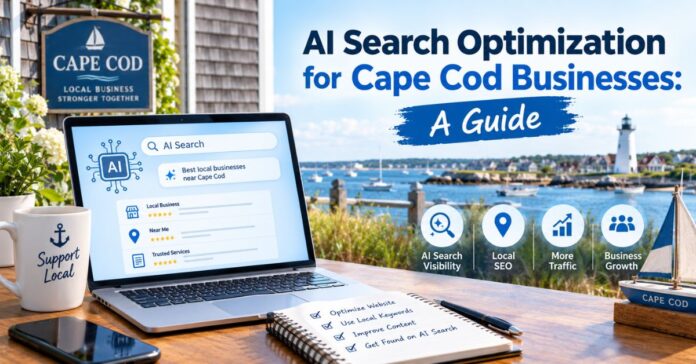
Search has changed more in the last few years than in the decade before it. Customers still type queries into Google, but they also ask conversational questions to AI assistants, see AI-generated summaries at the top of results pages, and expect instant, specific answers. For a small business on Cape Cod, whether you run a landscaping crew in Falmouth, a seafood restaurant in Chatham, or a boutique inn in Provincetown, this shift raises a practical question: how do you make sure your business is the one that gets mentioned?
This guide explains how AI-driven search works at a practical level, why local businesses are in a good position to benefit, and what you can do to your website and online presence to improve your chances of being surfaced.
What AI Search Actually Means for Local Businesses
When people talk about “AI search,” they usually mean one of three things:
- AI-generated summaries in traditional search results, where Google or Bing gives a short written answer above the usual list of links.
- Conversational assistants, such as chatbots that people ask for recommendations (“Who’s a reliable electrician near Hyannis?”).
- Voice and mobile assistants, which read out a single answer instead of presenting ten options.
In all three cases, the system is trying to produce one helpful response rather than a long list. That means it has to decide which sources to trust and which businesses to mention. If your website is vague, outdated, or inconsistent with the rest of the web, you are less likely to be chosen.
Working with a local Cape Cod SEO company can help you understand how these changes apply to your specific market, because AI-driven results lean heavily on the same signals that have always mattered in local search: clear information, consistent business details, genuine reviews, and content that actually answers questions. The difference is that the margin for sloppy or thin content is smaller than it used to be.
Why Cape Cod Is a Unique Search Market
Cape Cod is not a typical local market, and that matters for how you approach visibility.
Seasonality shapes search behavior. A large share of demand comes from visitors and seasonal residents who search before they arrive. They look for restaurants, rentals, activities, and services while planning a trip, often from hundreds of miles away. Year-round residents search for different things: contractors, medical offices, accountants, home services.
Towns matter. People rarely search for “Cape Cod” alone. They search by village or town, such as Orleans, Mashpee, Dennis, Brewster, Sandwich, or Wellfleet. A business that mentions only “Cape Cod” in general terms may miss the specific searches that bring in customers.
Reputation travels quickly. In a close-knit region, reviews and word of mouth carry real weight, and AI systems often draw on review content when summarizing which businesses are well regarded.
Competition is local but crowded. Many service categories have dozens of established providers within a short drive. Standing out requires specificity, not just presence.
How AI Systems Decide Which Businesses to Recommend
No one outside the companies that build these systems knows every detail of how recommendations are chosen, and anyone promising guaranteed placement in AI answers is overselling. But the general principles are well understood and consistent with long-standing search best practices.
Clarity and structure
AI systems extract information from pages. Content that is organized under clear headings, written in plain language, and focused on a single topic is easier to interpret than a wall of marketing copy. A page titled “Septic Inspections in Barnstable County” with a straightforward explanation of the service, the process, and the service area gives a system something concrete to work with.
Consistency across the web
Your business name, address, phone number, hours, and services should match across your website, your Google Business Profile, directory listings, and social profiles. When details conflict, trust drops, both for human customers and for automated systems trying to verify who you are.
Evidence of real-world credibility
Reviews, local mentions, years in business, licenses, certifications, and project examples all help establish that you are a real, active business with a track record. These are the kinds of signals that separate a genuine local provider from a generic listing.
Helpful, original content
Pages that answer real questions in useful detail tend to perform better than pages that simply repeat keywords. AI systems are designed to produce helpful answers, so they favor sources that provide them.
Practical Steps to Improve Your AI Search Visibility
You do not need to rebuild everything at once. The following steps are ordered roughly from foundational to advanced.
1. Start with a fast, mobile-friendly website
Many Cape Cod searches happen on phones, often while someone is standing on a beach, sitting in a car, or walking through a downtown. If your site loads slowly or is awkward on a small screen, visitors leave, and search systems notice. Reliable hosting, compressed images, and a clean mobile layout are not glamorous, but they are the base everything else rests on.
2. Build dedicated pages for each service and location
Instead of one “Services” page listing everything, create separate pages for your main offerings. If you serve multiple towns, consider location-specific pages with genuinely distinct information, such as local project examples, neighborhood details, or common issues in that area. Avoid copying the same page and swapping town names; that approach is thin and easily recognized as low value.
3. Answer the questions customers actually ask
Think about the questions you hear every week. A plumber might hear, “How do I winterize a seasonal home?” A wedding venue might hear, “What is your rain plan?” A dental office might hear, “Do you accept new patients?” Turn those questions into clear, honest answers on your site. Short FAQ sections, written in a natural voice, are particularly well suited to conversational and voice-based search.
4. Strengthen your Google Business Profile
For local businesses, your Google Business Profile is often the most important single asset outside your website. Keep it complete and current:
- Accurate categories, hours, and service areas
- Recent photos of your work, team, or location
- Timely responses to reviews, positive and negative
- Posts or updates about seasonal offerings and changes
Seasonal hours matter on the Cape. Updating them promptly prevents frustrated customers and incorrect information being repeated elsewhere.
5. Use structured data where it fits
Structured data, often called schema markup, is code that labels the information on your page: your business name, address, services, reviews, FAQs, and so on. It helps search systems understand your content without guessing. It is not a magic switch, and it only works when the visible content on the page is accurate and matches, but it is a sensible technical step for most local business sites.
6. Earn real local mentions
Local chambers of commerce, community organizations, regional publications, and partner businesses can all be sources of credible mentions. Sponsoring a local event, contributing expertise to a community resource, or being featured for a notable project builds the kind of reputation that carries over into search visibility. Quality and relevance matter far more than volume.
7. Keep content fresh and honest
Outdated pricing, closed locations, and old promotions undermine trust. Review your key pages at least a few times a year, and update them when something changes. If you offer seasonal services, say so clearly, and adjust before each season begins.
Common Mistakes to Avoid
Chasing shortcuts. Mass-produced AI-written pages, keyword-stuffed text, and purchased low-quality links may produce a brief bump, but they carry risk and rarely build lasting visibility.
Ignoring the basics. Many businesses worry about emerging AI features while their site has broken pages, missing contact information, or a Google Business Profile that has not been touched in years. Fix the fundamentals first.
Writing for machines instead of people. Content that reads awkwardly because it was built around a phrase tends to underperform with both visitors and algorithms. Write the way you would explain your service to a neighbor.
Neglecting measurement. Track what matters: calls, form submissions, direction requests, and where your visitors come from. Rankings and impressions are useful, but customer actions tell you whether your effort is working.
How to Know If Your Efforts Are Working
AI search is still evolving, and reporting tools are catching up. In the meantime, a few practical checks can give you a reasonable picture:
- Search for your main services plus your town names and see how your business appears, including in any AI-generated summaries.
- Ask a few of the common questions your customers ask and review which sources are cited or mentioned.
- Review your analytics for growth in branded searches, direct visits, and local actions such as calls and direction requests.
- Compare your Google Business Profile insights month over month, keeping seasonality in mind.
Because Cape Cod demand swings so sharply between summer and winter, compare against the same period in the previous year rather than the prior month.
A Realistic Way to Think About the Future
It is tempting to treat AI search as an entirely new discipline that makes everything you know obsolete. In practice, the businesses that tend to do well are the ones that were already doing the fundamentals well: a clear website, accurate listings, good reviews, and genuinely helpful content. AI changes how that information is packaged and delivered, but it still depends on the quality of what is available to draw from.
That is encouraging for local businesses. You do not need to out-spend national brands. You need to be the most clear, credible, and useful answer for the specific towns and customers you serve. A restaurant that clearly describes its menu, hours, and location, a contractor with detailed project pages and honest reviews, or a retailer with accurate seasonal information all give search systems solid reasons to include them.
Final Thoughts
AI search optimization is less about learning a new trick and more about making your business easy to understand, easy to verify, and genuinely helpful to the people you want to reach. Start with a fast, well-organized website. Keep your listings accurate. Create content that answers real questions in your own voice. Build a reputation that reflects the quality of your work.
For Cape Cod businesses, where seasons, towns, and community reputation all shape how customers find you, those fundamentals are especially powerful. Focus on them steadily, review your results with seasonality in mind, and adjust as the search landscape continues to evolve. The businesses that treat visibility as an ongoing part of running a company, rather than a one-time project, will be best positioned to be found wherever their customers choose to search.
see more: Why Businesses Are Outsourcing Statement Printing and Mailing in 2026