
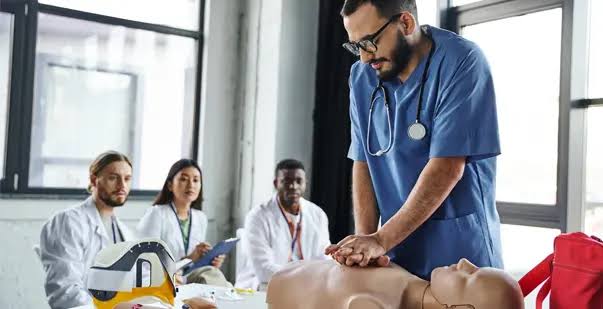
Healthcare professionals regularly encounter situations where immediate resuscitation skills affect how quickly emergency care begins. CPR certification provides healthcare providers with structured training in CPR, AED use, and basic life-support techniques. Training also includes hands-on practice, connecting classroom instruction with the physical skills required during emergencies. Here are the benefits of obtaining CPR certification for healthcare professionals:
Strengthen Resuscitation Skills
Basic Life Support (BLS) training develops practical skills for responding to cardiac emergencies involving patients of all ages. Healthcare providers practice CPR techniques for adults, children, and infants; AED training addresses defibrillation during cardiac arrest. Single-rescuer and team-based exercises also introduce different approaches to providing immediate assistance.
Hands-on training gives healthcare professionals an opportunity to perform the techniques rather than only study written procedures. Practice sessions cover CPR certification techniques, AED operation, and responses to choking emergencies under instructor guidance. Repeated skills practice helps connect the sequence of actions with the physical requirements of resuscitation.
BLS training also prepares healthcare professionals to apply these skills within the responsibilities of their specific roles. In a clinical setting, responding to a cardiac emergency requires more than performing individual techniques; staff must recognize an emergency, activate the appropriate response system, communicate with other members of the care team, and continue providing care until additional support arrives. Training helps connect individual BLS skills with the broader workflow used during clinical emergencies; this allows healthcare workers to understand how their actions contribute to an organized team response.
Manage Cardiac Emergencies
Advanced cardiovascular training focuses on the assessment and treatment of serious cardiac emergencies. ACLS instruction covers cardiac rhythm recognition, airway management, emergency medications, and care following cardiac arrest. It also addresses the clinical decisions involved in selecting appropriate interventions as a patient’s condition changes. Case-based training places these concepts in realistic clinical situations and reinforces the more advanced knowledge required for cardiovascular emergencies.
Support Pediatric Care
Pediatric emergencies require assessment and treatment approaches adapted to children and infants. PALS training focuses on pediatric assessment, resuscitation, treatment algorithms, and the recognition of changes in a child’s condition. Training also addresses age-appropriate CPR and the systematic management of pediatric emergencies. Key areas of pediatric training include:
- Assess children and infants during emergency situations
- Apply treatment algorithms based on pediatric conditions
- Perform age-appropriate CPR during pediatric resuscitation
- Recognize changes in a pediatric patient’s condition
Develop Teaching Skills
Healthcare professionals who meet the required qualifications can pursue BLS instructor training to teach basic life-support courses. BLS Instructor Training focuses on the skills required to deliver course content, demonstrate procedures, evaluate learner performance, and administer required assessments. The instructor pathway involves responsibilities that differ from those of a BLS provider, including:
- Present BLS course content clearly and effectively
- Demonstrate and supervise CPR and other required skills
- Prepare learners for skills evaluations and course assessments
- Evaluate learner performance according to course requirements
- Organize and conduct BLS training sessions
Instructor training places greater emphasis on education and learner assessment than on responding directly to patient emergencies. The course prepares qualified healthcare professionals to deliver BLS provider training within the requirements of the applicable training organization. Healthcare professionals pursuing this pathway should meet the organization’s eligibility requirements and follow its instructor-training standards.
Plan To Get Your CPR Certification
Healthcare professionals often have several training pathways that match different clinical responsibilities and professional goals. A provider focused on foundational response skills has different training needs from someone regularly managing cardiac emergencies or pediatric cases. Specialized courses also address ECG, pharmacology, peripheral IV procedures, and instructor development. Review the available course options for CPR training and select one that matches your current role and clinical responsibilities.