
Femoral nerve glides are gentle movements used in physical therapy to support nerve mobility and improve comfortable movement around the hips and thighs. These exercises are sometimes recommended for people experiencing certain types of nerve-related discomfort, stiffness, or movement restrictions. Unlike traditional muscle stretches, nerve glides involve controlled movements designed to change how nerves move relative to surrounding tissues.
Understanding how a femoral nerve glide works can help you recognize its role in rehabilitation and physical therapy. The technique focuses on the femoral nerve, which contributes to sensation and muscle movement in the front of the thigh and parts of the lower leg. When appropriately prescribed, nerve mobilization may complement strengthening exercises, movement training, and other treatments.
However, femoral nerve glides are not suitable for every type of hip, thigh, or knee pain. Incorrect movements or excessive stretching may aggravate sensitive nerves. This guide explains the purpose, potential benefits, common techniques, precautions, and best practices associated with femoral nerve gliding exercises.
What Is a Femoral Nerve Glide?
A femoral nerve glide is a controlled movement technique designed to encourage relative motion between the femoral nerve and surrounding tissues. Physical therapists may use these exercises as part of a rehabilitation program for certain nerve-related conditions. The movements usually involve coordinated changes in hip, knee, or other joint positions. Their purpose is to encourage comfortable nerve movement without creating unnecessary irritation.
Femoral nerve glides are also called femoral nerve flossing or neural mobilization exercises. These terms describe therapeutic approaches that influence how nerves respond to body movement. Unlike ordinary stretching, nerve gliding focuses on controlled motion rather than holding a muscle in an elongated position. The exact technique depends on the individual’s symptoms, physical examination, and rehabilitation goals.
A healthcare professional may recommend nerve gliding when an assessment suggests that nerve sensitivity or restricted neural movement contributes to discomfort. However, not every case of thigh tightness or knee pain involves the femoral nerve. Similar symptoms can arise from muscles, joints, or spinal conditions. Identifying the underlying cause helps determine whether nerve mobilization is an appropriate treatment option.
Understanding the Femoral Nerve and Its Function
The femoral nerve is an important peripheral nerve that originates from nerve roots in the lower back, primarily between the L2 and L4 spinal levels. It travels through the pelvis and into the front of the thigh. The nerve carries signals involved in muscle movement and sensation. Its normal function supports several everyday activities involving the hips and knees.
One important role of the femoral nerve is supplying muscles responsible for straightening the knee. It also contributes to hip flexion through its muscular branches. Sensory branches carry information from areas of the front and inner thigh. Through its saphenous branch, the nerve also provides sensation to portions of the inner lower leg.
When the femoral nerve becomes irritated or damaged, symptoms may affect strength, sensation, or comfortable movement. Some individuals experience discomfort in the front of the thigh, while others notice weakness when straightening the knee. These symptoms can have several possible causes. A medical assessment is important when weakness, persistent numbness, or unexplained pain develops.
How Does a Femoral Nerve Glide Work?
Femoral nerve gliding involves movements that alter the relationship between the nerve and surrounding muscles, joints, and connective tissues. Peripheral nerves normally accommodate changes in body position as people walk, bend, and perform everyday activities. Neurodynamic exercises are intended to encourage this movement in a controlled manner. Their effects depend on the technique and the condition being treated.
A commonly discussed approach is the nerve slider, which coordinates movements to increase mechanical loading at one end of a nerve pathway while reducing it at another. This differs from techniques that increase tension across a larger portion of the nerve. Sliders are generally intended to encourage movement without prolonged stretching. A therapist can determine which approach suits an individual’s needs.
Researchers continue investigating how neural mobilization affects pain, movement, and nervous system sensitivity. Some studies suggest potential benefits when these techniques are included within broader rehabilitation programs. However, evidence specific to femoral nerve gliding remains limited for many conditions. It should therefore be considered a possible treatment component rather than a guaranteed solution.
Potential Benefits of Femoral Nerve Gliding Exercises
One potential benefit of femoral nerve gliding is improved tolerance to movements that involve the hips and knees. When nerve sensitivity contributes to discomfort, carefully selected exercises may help certain individuals move more comfortably. This improvement can support participation in daily activities and rehabilitation. Results vary depending on the underlying condition and overall treatment program.
Femoral nerve mobilization may also complement exercises that address muscle strength, joint mobility, and movement coordination. Physical therapists sometimes combine these approaches when treating selected musculoskeletal conditions. The goal is to improve practical function rather than focusing on nerve movement alone. Successful rehabilitation usually considers multiple factors contributing to pain and movement difficulties.
It is important to understand that femoral nerve glides do not automatically repair nerve damage or eliminate nerve compression. Some conditions require medical investigation, medication, specialized rehabilitation, or other treatments. Improvement cannot be predicted simply because an exercise produces a stretching sensation. Treatment decisions should reflect an accurate diagnosis and individual response to therapy.
When Are Femoral Nerve Glides Recommended?
Physical therapists may consider femoral nerve gliding when examination findings suggest that neural sensitivity contributes to movement-related symptoms. This can involve discomfort around the anterior thigh or limitations associated with certain hip and knee movements. A clinician will usually assess strength, sensation, mobility, and symptom behavior. These findings help determine whether neurodynamic exercises are appropriate.
Some rehabilitation programs incorporate femoral nerve mobilization for selected patients with knee-related pain or nerve involvement. However, knee discomfort alone does not establish a femoral nerve problem. Symptoms may originate from the knee joint, surrounding muscles, or lumbar spine. Appropriate clinical evaluation helps distinguish these possibilities before selecting an exercise program.
Femoral nerve glides may not be appropriate during acute nerve injury or when symptoms are rapidly worsening. People with significant weakness, recent surgery, unexplained neurological changes, or severe pain require professional assessment. The same applies when discomfort appears after a substantial injury. Identifying contraindications is an essential part of safe rehabilitation planning.
How to Perform a Femoral Nerve Glide Safely
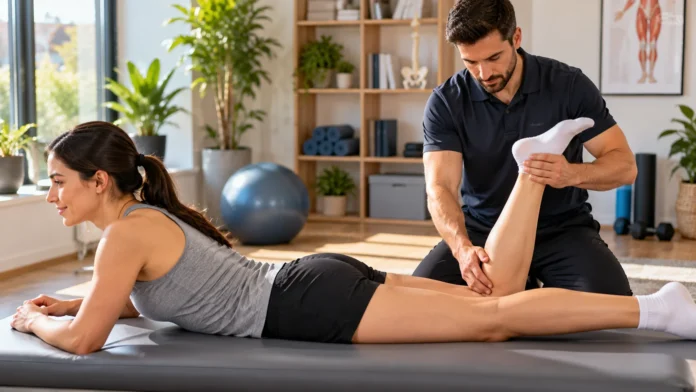
Femoral nerve gliding is commonly introduced by a physical therapist who can assess the individual’s symptoms and demonstrate appropriate movement. Some clinical techniques use a face-down position, while others use side-lying variations. The therapist considers hip alignment, knee movement, and spinal positioning. Different techniques place different demands on the nerve and surrounding tissues.
In a commonly used supervised slider variation, the person lies face down with the spine and pelvis supported in a neutral position. The therapist may guide coordinated knee bending and straightening with carefully selected neck movements. The motion is gentle and remains within an individually tolerated range. The purpose is not to force the heel toward the buttocks.
A therapist should establish the correct movement sequence, range, and repetition schedule before someone practices independently. Stop the exercise if sharp pain, increasing tingling, numbness, or weakness occurs. Avoid forcing movement to achieve a deeper stretch. Because nerve-related symptoms can have different causes, a generic exercise demonstration cannot replace individualized assessment.
Femoral Nerve Glide vs. Quadriceps Stretch
Femoral nerve glides and quadriceps stretches may appear similar because both can involve bending the knee. However, their purposes and movement patterns are different. A quadriceps stretch primarily aims to lengthen muscles along the front of the thigh. A nerve glide is designed to influence neural movement and sensitivity through coordinated positioning.
Traditional quadriceps stretches often involve holding the knee in a bent position for a specified period. Femoral nerve sliders generally use controlled, alternating movements rather than prolonged end-range holds. The amount of tension experienced by the nerve can depend on hip, knee, and spinal positioning. These differences matter when symptoms involve sensitive neural structures.
Neither technique is automatically better for every person experiencing anterior thigh discomfort. Muscle tightness may respond to appropriate flexibility exercises, while certain nerve-related problems may require a different rehabilitation approach. Sometimes both types of exercises are included in the same program. A physical therapist can identify which movements address the individual’s specific limitations.
Common Mistakes to Avoid During Femoral Nerve Glides
One common mistake is treating a femoral nerve glide like an aggressive stretching exercise. Pulling the leg forcefully or holding an uncomfortable position may increase nerve irritation. A stronger sensation does not necessarily indicate better results. Neurodynamic techniques should be performed within a range that is appropriate for the person’s symptoms and rehabilitation stage.
Another mistake is attempting advanced movements without understanding the correct body position. Excessive lower-back arching, uncontrolled hip movement, or awkward neck positioning can change the exercise considerably. These compensations may place unnecessary stress on other tissues. Professional instruction helps establish controlled movement patterns and reduces avoidable discomfort during exercise.
Ignoring changes in symptoms is also a concern during nerve mobilization. Increasing tingling, persistent numbness, or worsening pain should not be considered normal signs of progress. Continuing despite these responses may aggravate an underlying problem. Adjustments to the exercise or further medical assessment may be necessary before continuing a rehabilitation program.
How Often Should You Perform Femoral Nerve Glides?
The appropriate frequency of femoral nerve glides depends on the individual’s symptoms, diagnosis, and tolerance. There is no single repetition schedule that works for everyone. A physical therapist may begin with a conservative approach and assess the response before making changes. Exercise frequency should reflect clinical findings rather than a universal routine.
People with sensitive nerves may require different exercise volumes from those recovering comfortably within a structured rehabilitation program. The intensity, movement range, and coordination of the technique also influence tolerance. More repetitions do not necessarily produce faster improvement. A carefully selected program emphasizes controlled movement and an appropriate response rather than high exercise volume.
Follow the schedule provided by your treating clinician and report any changes in symptoms. If discomfort increases or persists after a session, the exercise may need adjustment. Progress can also be evaluated through everyday activities rather than exercise performance alone. Consistent communication with a healthcare professional helps guide safe decisions about frequency and progression.
Best Practices for Femoral Nerve Glide Exercises
The most important practice is obtaining an appropriate assessment before beginning nerve mobilization for unexplained symptoms. A clinician can evaluate whether discomfort originates from neural structures, muscles, joints, or the spine. This distinction guides exercise selection and rehabilitation planning. It also helps identify conditions that require medical treatment instead of movement-based therapy alone.
Controlled movement and comfortable positioning are essential during femoral nerve gliding exercises. The technique should not involve bouncing, forceful pulling, or deliberately provoking strong nerve symptoms. Maintain the body alignment demonstrated by the therapist throughout each movement. An individually adjusted range is generally more appropriate than attempting to achieve the greatest possible stretch.
Pay attention to how your body responds during and after rehabilitation sessions. Report new symptoms, increased discomfort, or changes in movement ability to your clinician. Avoid comparing your exercise range with another person’s because anatomical and clinical differences influence tolerance. A thoughtful rehabilitation approach prioritizes function, comfort, and gradual improvement.
Other Exercises That May Support Femoral Nerve Rehabilitation
Femoral nerve gliding is sometimes included in rehabilitation programs alongside exercises for surrounding muscles and joints. Strengthening the quadriceps may be important when weakness affects knee stability or everyday activities. Hip strengthening and movement retraining can also support overall lower-limb function. However, exercise selection should depend on the reason for the symptoms.
Gentle mobility exercises may be useful when joint stiffness or reduced movement contributes to discomfort. A physical therapist might assess hip mobility, knee movement, and lower-back function before recommending specific activities. The aim is to address relevant limitations without aggravating sensitive structures. Not every person with thigh pain needs the same exercises or rehabilitation approach.
Walking and other appropriate everyday activities may form part of recovery when they are comfortable and medically suitable. Gradual participation in ordinary movement can help maintain function during rehabilitation. However, significant weakness or unstable walking requires professional assessment before increasing activity. A comprehensive program considers individual abilities, symptoms, and recovery goals.
When to Stop and Seek Medical Advice
Femoral nerve-related symptoms should not be ignored when they involve noticeable weakness, persistent numbness, or difficulty walking. Problems with straightening the knee may indicate impaired muscle function or nerve involvement. These symptoms can have several possible causes. Prompt medical assessment helps identify the underlying condition and determine appropriate treatment.
Stop femoral nerve gliding if it causes sharp pain, increasing pins and needles, or worsening numbness. Do not attempt to push through symptoms that feel distinctly different from ordinary muscle movement. Seek urgent medical care for new or rapidly progressing leg weakness, particularly when accompanied by other neurological changes. New bladder or bowel control problems also require emergency assessment.
People recovering from surgery, significant injury, or known neurological conditions should obtain specific guidance before performing neurodynamic exercises. A rehabilitation technique that suits one condition may be inappropriate for another. Early professional assessment can prevent unnecessary delays in identifying important medical problems. Safe recovery depends on choosing treatments that match the individual’s actual condition.
Conclusion
Femoral nerve gliding is a movement-based rehabilitation technique intended to influence how the femoral nerve moves relative to surrounding tissues. It may be useful for selected people experiencing nerve-related movement difficulties when prescribed within an appropriate treatment plan. Understanding its purpose helps distinguish neural mobilization from ordinary muscle stretching.
The best practices for femoral nerve glides emphasize controlled movement, individualized instruction, and careful attention to symptoms. Forceful stretching, excessive repetitions, and ignoring discomfort can interfere with safe rehabilitation. Because research findings vary across conditions, these exercises should not be considered a guaranteed treatment for thigh, hip, or knee pain.
If you are considering femoral nerve gliding for persistent discomfort, begin with a qualified healthcare professional who can identify the likely cause. An appropriate assessment can determine whether nerve mobilization, strengthening, or another treatment is suitable. With careful guidance, femoral nerve glides may form one part of a broader plan to support comfortable movement and everyday function.
FAQs
What Is a Femoral Nerve Glide Used For?
A femoral nerve glide is used in selected physical therapy programs to encourage nerve mobility and address certain nerve-related movement symptoms. Its suitability depends on the underlying condition and professional assessment.
Can Femoral Nerve Glides Help With Thigh Pain?
Femoral nerve glides may help some people when nerve sensitivity contributes to thigh discomfort. However, thigh pain has many possible causes, and these exercises are not appropriate for every condition.
How Many Femoral Nerve Glides Should I Do?
There is no universal number of repetitions suitable for everyone. A physical therapist should recommend the appropriate movement range, repetitions, and frequency based on your symptoms and response to treatment.
Should a Femoral Nerve Glide Feel Painful?
Femoral nerve glides should not produce sharp pain, worsening tingling, or increasing numbness. Stop if these symptoms appear, and consult a healthcare professional before continuing or changing the exercise.
What Is the Difference Between a Femoral Nerve Glide and a Quad Stretch?
A quadriceps stretch primarily targets muscles at the front of the thigh. A femoral nerve glide uses controlled joint movements intended to influence neural mobility and sensitivity rather than simply lengthening muscles.