
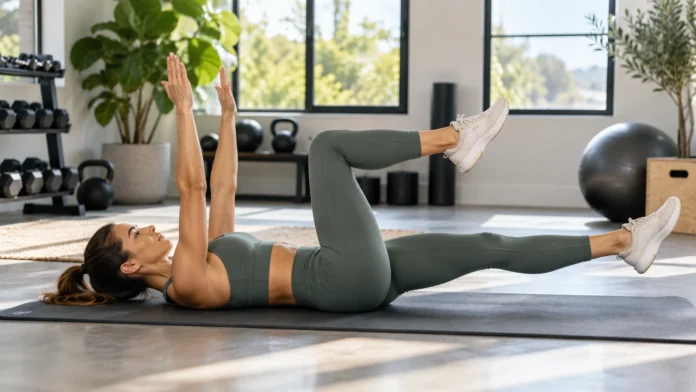
What Is the Deadbugs Workout?
The deadbugs workout is a core-strengthening exercise that helps improve abdominal stability, coordination, and controlled movement. It involves lying on your back while extending opposite arms and legs without allowing your lower back to arch excessively. Unlike traditional abdominal exercises that involve repeated bending, the dead bug focuses on maintaining a stable torso while your limbs move.
The exercise gets its unusual name from the starting position, which resembles a bug lying on its back with its arms and legs raised. Despite its simple appearance, the dead bug challenges several important muscles that support your spine and pelvis. It is commonly included in Pilates, rehabilitation programs, strength training routines, and beginner-friendly core workouts.
One of the biggest advantages of dead bugs is that they require little equipment and can be adapted for different fitness levels. You can perform the movement on a comfortable exercise mat using only your body weight. Learning proper dead bug exercise form helps you strengthen your core while developing better awareness of how your body moves.
What Muscles Does the Dead Bug Exercise Work?
The dead bug primarily challenges the abdominal muscles responsible for stabilizing the trunk during movement. These include the transverse abdominis, rectus abdominis, and internal and external obliques. Together, these muscles help control the position of your rib cage, pelvis, and spine as your arms and legs move away from your body.
The transverse abdominis contributes to abdominal tension and trunk support, while the obliques help resist unwanted rotation. The rectus abdominis assists in controlling spinal and pelvic positioning. These muscles work together rather than functioning independently, making the dead bug a useful exercise for developing coordinated core strength and controlled movement patterns.
Other muscles also participate, including the hip flexors and muscles responsible for moving and supporting the shoulders. Their activity depends on the variation and range of motion used. The main challenge is maintaining torso stability while your limbs move, rather than trying to lift heavy resistance or complete repetitions as quickly as possible.
How to Do the Dead Bug Exercise Step by Step
Begin by lying comfortably on your back on an exercise mat with your knees bent and feet resting on the floor. Raise both arms toward the ceiling, positioning your hands approximately above your shoulders. Then lift your legs individually until your hips and knees are bent at roughly ninety degrees, creating a controlled tabletop position.
Gently tighten your abdominal muscles while keeping your rib cage and pelvis steady. Slowly extend your right arm behind your head while moving your left leg forward toward the floor. Only lower your limbs as far as you can comfortably maintain control, avoiding excessive arching or twisting through your lower back.
Return your arm and leg to the starting position before repeating the movement with your left arm and right leg. Continue alternating sides using slow, deliberate movements and comfortable breathing. Focus on maintaining a stable torso throughout the exercise rather than trying to reach the floor with your hands or heels during every repetition.
Benefits of the Deadbugs Workout for Core Strength
The dead bug exercise helps strengthen the muscles that stabilize your trunk during everyday movement and physical activity. Its controlled arm and leg movements create a challenge that requires the abdominal muscles to resist changes in spinal position. With regular practice, the exercise can contribute to improved core endurance and greater control during other exercises.
Another benefit is that dead bugs develop coordination between the upper and lower body. Moving opposite limbs while maintaining a stable torso requires attention to timing, balance, and movement quality. This pattern can support general exercise skills used in activities such as walking, running, and strength training, although benefits vary according to individual fitness levels.
The exercise is also accessible because it can be modified without requiring heavy equipment or complicated techniques. Beginners can shorten their movement range, while experienced exercisers can gradually introduce more challenging variations. This flexibility makes dead bugs a practical addition to balanced workout programs that include different types of strengthening and mobility exercises.
How Dead Bugs Support Spinal Stability and Posture
Spinal stability involves controlling the position of the trunk while the arms and legs perform different movements. The dead bug challenges this ability by requiring the abdominal muscles to maintain a steady torso. Practicing controlled movement can improve awareness of spinal and pelvic positioning, which is useful during many everyday tasks.
The exercise also encourages coordination between the rib cage, pelvis, and breathing muscles. Learning to maintain abdominal tension without holding your breath can help develop more efficient movement habits. However, the goal is not to force your lower back completely flat or maintain one rigid posture during every activity outside the workout.
Dead bugs can contribute to a general strengthening program that supports comfortable movement and physical function. Nevertheless, they are not a guaranteed solution for poor posture or back pain, which can have many causes. Combining core exercises with regular activity, appropriate strength training, and comfortable movement variety provides a more balanced approach to musculoskeletal health.
Common Dead Bug Exercise Mistakes to Avoid
One common mistake is lowering the arms and legs too far before developing enough abdominal control. This can cause the lower back to arch excessively or the pelvis to move away from its starting position. Shortening the movement range allows you to practice the exercise more comfortably while developing the strength needed for larger movements.
Another mistake is rushing through repetitions without controlling the return to the starting position. Fast movements can make it harder to notice unwanted twisting or shifting through the torso. Performing each repetition slowly gives you more time to coordinate your breathing, maintain appropriate muscle tension, and recognize when your technique begins to change.
Some people also hold their breath or create unnecessary tension in the neck and shoulders. Keep your head supported by the floor and allow your shoulders to remain comfortable throughout the exercise. If you notice strain or unusual discomfort, reduce the difficulty and focus on smoother movements instead of forcing yourself to complete additional repetitions.
How to Breathe Properly During Dead Bugs
Breathing plays an important role in the dead bug exercise because it helps coordinate abdominal activity with controlled limb movement. Begin by taking a comfortable breath while preparing your starting position. As you extend your opposite arm and leg, exhale gently and maintain enough abdominal tension to keep your torso steady.
Inhale as you return to the starting position, allowing your breathing to remain natural rather than exaggerated. Repeat the same pattern on the opposite side without holding your breath unnecessarily. Some people prefer a slightly different breathing rhythm, but consistent, comfortable breathing is generally more useful than forcing a rigid pattern.
Avoid bracing so strongly that you cannot breathe or move comfortably. The exercise should feel controlled rather than strained, particularly when practicing beginner variations. If coordinating breathing and limb movement feels difficult, start with smaller movements and practice the breathing pattern separately before attempting the complete dead bug exercise.
Beginner Dead Bug Exercise Variations
Beginners can start with a heel slide variation before attempting the traditional dead bug. Lie on your back with your knees bent and feet on the floor, then slowly slide one heel forward. Keep your torso steady and return the foot to its starting position before switching sides, using a comfortable movement range.
Another beginner-friendly option is the dead bug heel tap. Start with your knees bent in a tabletop position and gently lower one heel toward the floor while keeping the opposite leg still. Return to the starting position and repeat with the other leg, focusing on abdominal control rather than lowering quickly.
You can also perform an arms-only dead bug variation while keeping both feet on the floor. Extend one arm overhead and return it before moving the other side. Once these simpler movements feel manageable, gradually combine opposite arm and leg movements to progress toward the traditional version without rushing the learning process.
Advanced Dead Bug Variations for Stronger Core Training
Once you can perform the standard dead bug with consistent control, you may explore more challenging variations. Extending your legs farther from your body increases the demand on your abdominal muscles. However, progression should depend on your ability to maintain comfortable spinal positioning rather than reaching a particular distance or difficulty level.
A resistance band dead bug can introduce additional upper-body tension when performed with suitable equipment and correct technique. Another option involves holding a lightweight object while moving the opposite leg, provided the extra resistance does not affect control. These variations should be introduced gradually because greater resistance is not always necessary for effective strengthening.
The straight-leg dead bug is another challenging variation that increases the leverage of the moving legs. Begin with a smaller range and stop if your lower back starts arching excessively. Advanced movements are most useful when they improve controlled strength rather than simply making the exercise harder without providing additional practical benefit.
How Many Dead Bug Repetitions Should You Do?
The ideal number of dead bug repetitions depends on your experience, exercise goals, and ability to maintain proper technique. Beginners may start with five to eight controlled repetitions on each side. This provides an opportunity to practice coordination and abdominal engagement without allowing fatigue to interfere significantly with movement quality.
As your technique improves, you can gradually increase the number of repetitions or perform additional sets. Two or three manageable sets may be appropriate within a general fitness routine, although there is no requirement to reach a particular number. Stop or rest when you can no longer maintain consistent positioning and comfortable breathing.
Quality matters more than completing a large number of repetitions because the dead bug is primarily a controlled stability exercise. Performing fewer movements correctly can be more productive than rushing through a longer set. Allow appropriate recovery between sessions and adjust the workload according to your comfort, training experience, and other physical activities.
Dead Bug vs. Plank: Which Exercise Is Better?
Dead bugs and planks are both useful core exercises, but they challenge the body in different ways. The dead bug emphasizes maintaining trunk stability while the arms and legs move. A traditional plank requires the body to maintain a supported position against gravity, involving the abdominal muscles alongside the shoulders and other stabilizing structures.
Dead bugs are performed while lying on your back, making them accessible for people who find certain weight-bearing positions uncomfortable. Planks place more demand on the shoulders, arms, and supporting muscles while challenging trunk endurance. Neither exercise is automatically superior, because their usefulness depends on individual needs, preferences, and the overall training program.
Combining both exercises can provide variety and help develop core strength through different movement patterns. Beginners may find modified dead bugs easier to learn before progressing to more demanding stability exercises. Choose variations that allow controlled movement and comfortable breathing rather than comparing exercises only by how difficult they feel.
How to Add Dead Bugs to Your Workout Routine
Dead bugs can be included in a warm-up, dedicated core session, or full-body workout depending on your goals. Performing a few controlled repetitions before other exercises may help you practice trunk positioning and movement awareness. They can also serve as a standalone core-strengthening activity when combined with complementary exercises.
A simple core routine might include dead bugs, bird dogs, and modified side planks to challenge stability through different positions. These movements work together to create variety without requiring extensive equipment. Start with manageable sets and allow enough rest to perform each exercise comfortably, especially when learning unfamiliar techniques.
You do not need to perform dead bugs every day to benefit from consistent practice. Including them several times throughout the week can be sufficient within a balanced exercise program. Adjust frequency based on recovery, other training activities, and personal comfort, remembering that general physical activity and varied strengthening remain important for overall fitness.
Are Dead Bugs Safe for People With Lower Back Pain?
Dead bugs are sometimes included in exercise programs designed to improve trunk control for people experiencing lower back discomfort. Their supported starting position and adjustable movement range may make them suitable in certain situations. However, back pain has many possible causes, and an exercise that feels comfortable for one person may not be appropriate for another.
If you experience lower back pain, begin with a gentle variation only when the movement feels comfortable and has been recommended where necessary. Avoid extending the limbs beyond your ability to maintain control. Stop if the exercise causes sharp pain, increasing symptoms, numbness, or discomfort that persists after finishing the movement.
People with ongoing back conditions, recent injuries, or movement restrictions should seek guidance from a qualified healthcare professional before introducing unfamiliar exercises. A physical therapist can recommend suitable modifications based on individual needs. The purpose of core training is to support comfortable function, not to push through pain or replace appropriate medical evaluation.
Conclusion
The deadbugs workout is a practical core-strengthening exercise that challenges abdominal stability, coordination, and controlled movement. Its alternating arm and leg pattern helps develop awareness of how the torso remains steady during different activities. Because the exercise requires minimal equipment, it can be included in home workouts, beginner fitness programs, and broader strength training routines.
Proper dead bug technique involves maintaining comfortable spinal positioning, coordinating opposite arm and leg movements, and breathing naturally throughout each repetition. Beginners can start with heel taps or shorter movements before progressing toward the full exercise. More challenging variations can be introduced gradually as strength and coordination improve without sacrificing movement quality.
For the best results, treat the dead bug as one part of a balanced fitness routine rather than a complete solution for every core training goal. Combine it with other suitable exercises, regular movement, and adequate recovery. Consistent practice and thoughtful progression can help develop stronger trunk control while supporting comfortable everyday physical activity.
Frequently Asked Questions
What is the deadbugs workout good for?
The deadbugs workout helps strengthen core muscles, improve coordination, and develop trunk stability. It teaches the abdominal muscles to control spinal and pelvic positioning while the arms and legs move.
How many dead bugs should beginners do?
Beginners can start with five to eight controlled repetitions per side, adjusting the number according to comfort and technique. Focus on slow movements and consistent breathing rather than completing as many repetitions as possible.
Do dead bugs help strengthen your abs?
Yes, dead bugs challenge the rectus abdominis, transverse abdominis, and oblique muscles. They are particularly useful for developing abdominal stability and controlled movement as part of a balanced strengthening routine.
Can you do dead bugs every day?
Gentle practice may be manageable for some people, but daily training is not necessary. Your exercise frequency should reflect your experience, recovery, overall routine, and ability to maintain comfortable technique.
Are dead bugs better than crunches for core strength?
Dead bugs and crunches train the abdominal muscles differently. Dead bugs emphasize trunk stability during limb movement, while crunches involve spinal flexion. Both can be useful when selected according to individual fitness goals.