
A fence does more than mark where your property ends. It shapes how your yard feels, how safe your kids and pets are, how much privacy you get on a summer evening, and how your home looks from the street. In the Charleston Tri-County area, where salt air, summer humidity, sudden storms, and sandy soil all put pressure on outdoor structures, the material you choose matters even more than it would in a drier, calmer climate.
This guide compares three popular options for residential properties: wood, aluminum, and living fences. Each has real strengths and real trade-offs. By the end, you should have a clear sense of which one fits your property, your budget, and the way you actually use your yard.
Why the Lowcountry Climate Changes the Fence Conversation
Before comparing materials, it helps to understand what a fence faces along the South Carolina coast. Humidity is high for much of the year, which encourages mildew, rot, and insect activity in organic materials. Homes near the water, whether on Isle of Palms, Sullivan’s Island, Folly Beach, or the marshes of Mount Pleasant, also deal with salt in the air that can corrode unprotected metal. Add hurricane season and the occasional strong afternoon thunderstorm, and a fence has to handle both steady moisture and sudden wind loads. This is why many homeowners talk with a local installer such as FenceCraft before settling on a style, since crews who build here every day understand how coastal conditions affect each material in practice.
Soil is another factor. Many Lowcountry lots have sandy or damp ground with a high water table, which affects how deeply and securely posts need to be set. A well-built fence in this region starts below ground, with properly set posts and good drainage, and only then becomes a question of style.
Keeping these conditions in mind makes the comparison below far more practical. A material that looks great in a catalog may perform very differently a few miles from the ocean.
Wooden Fences: Classic Warmth and Real Privacy
Wood remains the most common residential fence material in the region, and for good reason. It suits traditional Southern architecture, it can be built at almost any height, and it offers the most straightforward path to full privacy.
The main benefits of wood
Privacy and noise softening. A solid board or shadowbox-style wood fence blocks sightlines into your yard, which is valuable on smaller lots or in neighborhoods where homes sit close together. Dense boards also take some of the edge off street noise.
Natural appearance. Wood blends into landscaping in a way few other materials can. Whether you prefer the honey tones of a clear sealant, a deeper stain, or a painted white finish, it can be adapted to match a historic home in downtown Charleston or a newer build in Summerville.
Flexibility of design. Picket fences, privacy panels, board-on-board, lattice tops, and custom gates are all achievable. If you want a fence that echoes the trim or porch details of your house, wood is the easiest material to customize.
Repairability. When a single board is damaged, it can usually be replaced without redoing the whole section. That makes maintenance more manageable over the long run.
What to plan for
Wood is a living material in the sense that it responds to its environment. In humid, coastal conditions, untreated boards can warp, split, or grow mildew. Choosing an appropriate wood species, using pressure-treated lumber where suitable, and applying a quality stain or sealant every few years makes a significant difference. Fasteners and hardware should be corrosion-resistant, especially closer to the coast.
Wood is a good match for homeowners who want maximum privacy, enjoy a traditional look, and are willing to do periodic upkeep in exchange for warmth and character.
Aluminum Fences: Low Maintenance and Clean Lines
If wood is the traditional choice, aluminum is the practical one. Aluminum fencing is popular around pools, front yards, and properties where the goal is definition and security rather than total seclusion.
The main benefits of aluminum
Resistance to rust. Unlike steel, aluminum does not rust, and a powder-coated finish adds another protective layer. That makes it well suited to a climate with high humidity and salt exposure. It is one of the reasons aluminum has become a go-to option for coastal homes.
Very little maintenance. There is no staining, sealing, or repainting on a regular schedule. An occasional rinse with a garden hose to remove dirt and salt residue is usually enough to keep it looking sharp.
Open views. Because aluminum fences are built with spaced pickets, they keep your view of the yard, marsh, pond, or golf course intact. For waterfront and view-oriented properties, that is a major advantage.
Safety and pool compliance. Aluminum panels can be built to heights and picket spacing that meet common pool-barrier expectations, and self-closing, self-latching gates are widely available. Always confirm current local requirements with your municipality or county before installation, since rules vary by jurisdiction.
Durability against pests and weather. Termites and rot are non-issues, and the material holds its shape through heavy rain and heat.
What to plan for
The trade-off is privacy. An aluminum fence marks a boundary and contains children and pets, but it does not hide your yard. Some homeowners solve this by pairing aluminum with landscaping, which brings us to the third option.
Aluminum works especially well for homeowners who want an elegant, long-lasting fence with minimal upkeep, particularly in salt-exposed or view-focused settings.
Living Fences: Privacy That Grows
A living fence uses plants, most often shrubs, hedges, or tightly spaced trees, as the barrier. It is the least conventional option of the three, but for the right property it can be the most beautiful and the most beneficial to the local environment.
The main benefits of a living fence
Natural privacy and a softer look. A well-chosen hedge creates a green wall that feels more like a garden than a boundary. It can screen a neighbor’s view, hide utility equipment, or frame a patio.
Wildlife and pollinator value. Native and regionally adapted plants can provide shelter and food for birds, bees, and butterflies. If you enjoy a yard that feels alive, a hedge can support that.
Wind and sound buffering. Dense plantings can slow wind and diffuse noise better than some hard surfaces, which tend to reflect sound rather than absorb it.
Environmental benefits. Plants take in carbon dioxide, help manage shade and heat around the home, and can assist with stormwater absorption, which matters in a low-lying coastal region.
What to plan for
A living fence takes time. Young plants need regular watering and pruning while they establish, and it can take a few growing seasons to reach full density. Species selection is critical in the Lowcountry: plants must tolerate heat, humidity, occasional flooding, and in some areas salt spray. A hedge also does not contain pets or small children on day one the way a built fence does, and it can be affected by disease, drought, or storm damage.
For many homeowners, the smartest approach is a hybrid. An aluminum or wood fence provides immediate security and structure, while shrubs or climbing plants grow alongside it to add privacy and beauty over time.
How to Choose: Questions Worth Asking Before You Build
Rather than starting with a material, start with your goals. A few questions can narrow the decision quickly.
What is the fence for? Privacy, pool safety, keeping pets in, defining property lines, and boosting curb appeal each favor different materials.
How close are you to salt water? The nearer to the coast, the more important corrosion resistance and hardware quality become. Aluminum and properly treated wood both perform well when chosen and installed correctly.
How much maintenance are you comfortable with? Be honest. A wood fence that is stained on schedule can last for many years, while one that is neglected will decline quickly. Aluminum asks for little, and a living fence asks for steady gardening attention.
What do your neighborhood rules say? Many communities in the Charleston area have homeowners association guidelines, historic district requirements, or municipal rules on height, style, and setbacks. Check these before you fall in love with a design.
What is your long-term plan? If you expect to stay in the home for many years, upfront quality and lower maintenance may outweigh initial cost. If you are preparing to sell, a fence that improves curb appeal and looks well maintained can be a selling point.
The Value of Local Installation Experience
Even the best material will underperform if it is installed poorly. Post depth, spacing, concrete footings, gate hardware, and grading all affect how a fence stands up to Lowcountry weather. A crew that regularly builds in coastal soil and understands local permitting can spot potential issues early, from drainage concerns to utility lines to property-line questions.
When comparing contractors, it is reasonable to ask about the materials they recommend for your specific location, how they set posts in sandy or wet ground, what warranties cover, and how they handle permits. Written estimates that spell out materials, height, gate details, and timelines make it easier to compare offers fairly.
Comparing the Three at a Glance
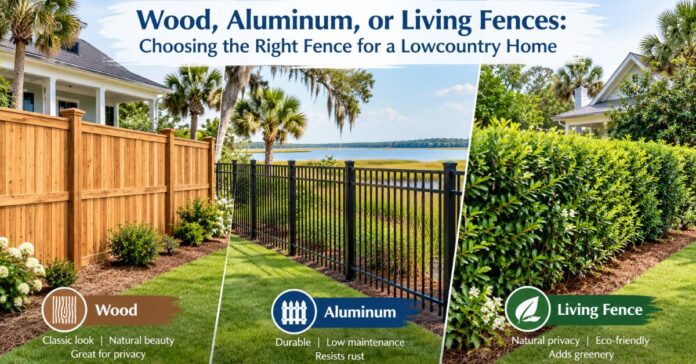
Wood offers the strongest privacy and the most design flexibility, with moderate ongoing upkeep. Aluminum provides open views, excellent durability against moisture, and minimal maintenance, with limited privacy. A living fence delivers natural beauty, habitat value, and a softer look, but it requires patience and ongoing care, and it does not offer instant security.
None of these is universally best. The right choice depends on where your home sits, what you want the fence to do, and how much time you want to spend caring for it.
Combining Fence Types for the Best Result
Some of the most successful residential fences are combinations. Consider a few common pairings:
- Aluminum with hedging: A slim aluminum fence supplies security and pool compliance while evergreen shrubs grow up behind it for privacy.
- Wood privacy panels with a decorative front section: A solid wood fence around the backyard, transitioning to an open picket or aluminum style at the front, gives you seclusion where you want it and curb appeal where it counts.
- Wood or aluminum with climbing plants: Native vines on a trellis-style section soften the look and add seasonal color without the wait of a full hedge.
Mixing materials also lets you spend where it matters most, such as investing in higher-end materials on the street-facing side and using a simpler approach along the back boundary.
Practical Care Tips for Long-Lasting Results
Whichever route you choose, a little routine attention goes a long way.
For wood, inspect boards and posts each spring and fall, re-seal or restain on a regular schedule, keep soil and mulch from piling against the bottom of the boards, and trim vegetation that traps moisture. For aluminum, rinse off salt and dirt periodically, check gate hinges and latches, and touch up any scratches in the finish promptly. For living fences, prune at the right time of year for your chosen species, water new plantings consistently, mulch to retain moisture, and watch for pests or disease after wet seasons.
After any major storm, walk the fence line to check for leaning posts, loose panels, or fallen limbs. Catching small problems early is almost always cheaper than fixing large ones later.
Final Thoughts
Choosing a fence is a decision about how you want to live in your space. Wood offers timeless warmth and privacy, aluminum delivers durable, low-maintenance elegance that handles coastal conditions gracefully, and a living fence brings texture, wildlife, and natural beauty that grows better with time. For many Charleston-area homeowners, the ideal solution blends these strengths rather than forcing a single choice.
Take the time to walk your property, think about how you use each part of it, and weigh privacy, upkeep, safety, and budget together. Pair that with a well-planned installation suited to Lowcountry conditions, and your fence will do far more than mark a boundary. It will add comfort, security, and lasting value to your home for years to come.