
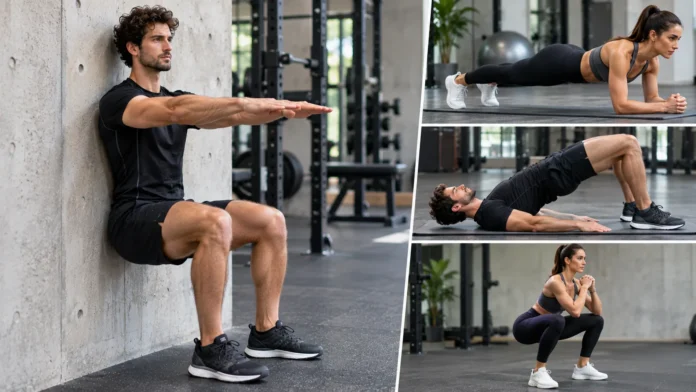
Building strength does not always require lifting weights or performing repeated movements. Sometimes, holding a position without moving can challenge your muscles and improve physical control. This training method is known as isometric exercise, and it is commonly used in strength training, fitness routines, and certain rehabilitation programs. However, understanding proper technique is important for performing these exercises comfortably and effectively.
Isometric holds are exercises in which muscles produce force while the joints remain relatively stationary. Popular examples include planks, wall sits, and static glute bridges. These movements can help develop muscular endurance, support joint stability, and improve body awareness. This guide explains how isometric holds work, their benefits, correct form, beginner-friendly variations, and practical tips for including them in a balanced fitness routine.
What Are Isometric Holds?
Isometric holds are a type of muscle contraction in which a muscle produces tension without creating noticeable movement at the joint. The muscle remains active while the body maintains a particular position. Unlike exercises involving repeated lifting and lowering, isometric training emphasizes controlled, static effort. This makes it useful for developing strength in specific positions.
For example, holding a plank requires your abdominal and supporting muscles to remain active while your body stays relatively still. Similarly, a wall sit challenges the leg muscles without repeated knee movement. These exercises may appear simple, but maintaining proper positioning requires coordination. The amount of muscular effort depends on the position and resistance involved.
Isometric exercises can be performed using body weight, resistance bands, or suitable exercise equipment. Some involve holding against gravity, while others involve pushing or pulling against an immovable object. Different variations challenge different muscle groups. Understanding these options helps you choose movements that suit your experience and physical abilities.
How Do Isometric Exercises Work?
Isometric exercises work by creating muscle tension while joint angles remain approximately unchanged. Muscle fibers generate force to maintain the required position or resist an external load. Although the body appears stationary, the muscles continue working. This sustained activity distinguishes isometric contractions from movements involving noticeable joint motion.
During a static hold, the nervous system coordinates muscle activity to maintain stability. The primary muscles generate force, while surrounding muscles may help support posture and alignment. For example, a plank challenges the trunk muscles while the shoulders and legs provide additional support. This coordinated effort contributes to controlled positioning.
The intensity of an isometric exercise depends on how much force the muscles must produce. Holding a comfortable position may require relatively little effort, while maintaining a demanding position can be challenging. Increasing resistance or changing leverage can modify difficulty. Appropriate progression helps build strength without requiring unnecessary strain.
What Muscles Do Isometric Holds Work?
Isometric holds can challenge many different muscle groups depending on the selected exercise. Planks primarily train the abdominal and trunk stabilizing muscles, while wall sits emphasize the quadriceps and supporting leg muscles. Static glute bridges involve the gluteal muscles and other hip stabilizers. Each movement creates tension in a different position.
The shoulders, arms, and back can also be trained through isometric exercises. Holding a suitable resistance band position or maintaining a controlled carry can challenge upper-body muscles. Some movements require several muscle groups to work together. This makes isometric training useful for practicing whole-body stability.
No single isometric hold trains every muscle equally. The muscles involved depend on joint position, exercise technique, and resistance. Combining different exercises provides broader coverage of major muscle groups. A balanced routine should include movements that challenge the upper body, lower body, and trunk appropriately.
Benefits of Isometric Holds for Muscle Strength
One important benefit of isometric holds is their ability to improve muscular strength when performed with sufficient effort. The muscles generate force against resistance even though the joints remain relatively still. This creates a training stimulus that can support strength development. Results depend on exercise intensity, consistency, and individual training experience.
Strength improvements from isometric exercise are often greatest near the joint angles used during training. This means holding one position does not necessarily improve strength equally throughout an entire movement. Practicing appropriate positions can help address specific strength needs. However, dynamic exercises remain useful for developing strength across larger movement ranges.
Isometric holds can complement traditional resistance training rather than replace every other exercise. They may be useful when a person wants to practice maintaining force in a particular position. Combining static and dynamic movements can provide varied muscular challenges. Appropriate recovery remains important, especially when holds require substantial effort.
How Isometric Holds Improve Muscular Endurance
Muscular endurance describes a muscle’s ability to maintain or repeat activity over time. Isometric holds can challenge this ability by requiring muscles to sustain tension for a controlled period. As the hold continues, maintaining the position may become more demanding. Training can gradually improve tolerance for suitable sustained efforts.
For example, holding a comfortable plank requires the trunk muscles to remain active while the body stays aligned. A wall sit challenges the leg muscles in a similar way. These exercises encourage awareness of posture during sustained muscular effort. However, longer holds are not automatically more beneficial than shorter, well-controlled efforts.
Muscular endurance develops through appropriately challenging activity and consistent practice. Beginners can start with brief holds and gradually adjust the duration as their control improves. Rest periods allow the muscles to recover between attempts. Quality technique should remain more important than achieving an unusually long holding time.
Isometric Holds for Core Stability
Core stability involves coordinating the muscles around the abdomen, back, and pelvis to control body position. Isometric exercises can help train this ability because they require the trunk to resist unwanted movement. Planks and side planks are common examples. These movements challenge different aspects of trunk control.
During a standard plank, the abdominal muscles work alongside the shoulders, hips, and legs to maintain alignment. Side planks place additional demands on muscles that help resist sideways bending. Both exercises require controlled breathing and appropriate positioning. Their difficulty can be modified according to experience.
Core stability is useful for everyday movements such as standing, lifting objects, and maintaining balance. However, isometric exercises should not be viewed as guaranteed solutions for back pain. Individual needs vary, particularly when discomfort or injury is present. A broader strengthening program can provide more complete movement preparation.
How to Perform Isometric Holds Correctly
Proper isometric form begins with selecting an exercise and position that match your ability. Start with a comfortable posture and engage the muscles required to maintain it. Avoid forcing your joints into uncomfortable angles. The aim is creating controlled muscular tension while keeping the rest of your body appropriately supported.
Maintain steady breathing throughout the hold instead of holding your breath. Focus on keeping your posture consistent without excessive shaking or compensatory movement. If your alignment begins to change significantly, the exercise may be too demanding. Shortening the hold or choosing an easier variation can help.
End the hold gradually and allow your muscles to relax before repeating it. Avoid suddenly releasing heavy resistance or collapsing out of the position. Rest as needed between attempts. Consistent technique helps make static training more manageable and reduces unnecessary stress on supporting joints.
Plank Holds: A Beginner-Friendly Isometric Exercise
The plank is one of the most recognizable isometric exercises. It challenges the muscles responsible for stabilizing the trunk while the body remains in a relatively straight position. Planks can be performed on the forearms or hands. Beginners may find an elevated variation more comfortable.
To perform a forearm plank, place your elbows beneath your shoulders and extend your legs behind you. Support your body through your forearms and toes while keeping your hips aligned with your trunk. Breathe normally and avoid excessive lower-back arching. Maintain the position only while your technique remains comfortable.
If a standard plank feels too demanding, place your forearms on a stable elevated surface. This reduces the difficulty while allowing similar positioning practice. Start with brief holds and rest between attempts. Avoid continuing if you experience sharp discomfort in your shoulders, wrists, or lower back.
Wall Sit Holds for Lower-Body Strength
Wall sits are isometric exercises that primarily challenge the quadriceps and surrounding lower-body muscles. They involve maintaining a seated-like position while the back rests against a wall. The exercise requires no specialized equipment. Its difficulty depends largely on knee angle and holding duration.
Stand with your back against a stable wall and position your feet a comfortable distance forward. Slowly bend your knees and slide downward until you reach a manageable position. Keep your feet planted and your back supported. You do not need to lower your thighs until they are parallel to the floor.
Hold the position while breathing steadily and keeping your knees aligned comfortably with your feet. If the position causes knee discomfort, reduce the depth or stop the exercise. Gradually return to standing when finished. A higher wall sit can provide a suitable starting option for beginners.
Glute Bridge Holds for Hip Strength
The glute bridge hold is a simple isometric movement that challenges the gluteal muscles and surrounding hip stabilizers. It begins from a lying position with the knees bent. The hips are lifted and maintained in a controlled position. This exercise can complement other lower-body strengthening movements.
Lie on your back with your feet flat on the floor and your knees comfortably bent. Gently lift your hips while keeping your shoulders supported. Avoid arching your lower back excessively to raise the hips higher. The movement should feel controlled and comfortable.
Maintain the bridge position for a brief period while breathing naturally. Lower your hips slowly and rest before repeating the exercise. You can adjust the height of the bridge according to your comfort. Proper technique is more important than lifting the hips as high as possible.
Side Plank Holds for Lateral Core Control
Side planks challenge muscles involved in resisting sideways movement of the trunk. They can also involve the shoulders, hips, and supporting leg muscles. This makes them useful for practicing coordinated stability. Several variations allow the difficulty to be adjusted according to experience.
Begin by lying on one side with your elbow positioned beneath your shoulder. Bend your knees for a beginner variation and gently lift your hips away from the floor. Maintain a comfortable line between your shoulders, hips, and knees. Avoid allowing the supporting shoulder to collapse.
Hold the position briefly while continuing to breathe. Lower your hips with control and repeat on the opposite side. If the exercise causes shoulder discomfort, choose another core movement. Progress toward a straight-leg variation only when you can maintain comfortable alignment.
Isometric Holds vs. Dynamic Exercises
Isometric exercises involve producing muscular force without noticeable joint movement. Dynamic exercises involve movement through a range of motion, such as the lowering and rising phases of a squat. Both forms of training challenge muscles. However, they develop strength through different movement demands.
For example, a wall sit requires the leg muscles to maintain a static position. A regular squat involves repeated bending and extending of the hips and knees. Each exercise can contribute to lower-body training. Neither one is automatically superior for every goal or individual.
Dynamic movements often provide opportunities to develop strength through broader joint ranges. Isometric exercises may be useful for practicing force production at specific positions. Combining both methods can support a well-rounded program. Exercise selection should reflect personal ability, comfort, and overall training goals.
How Long Should You Hold Isometric Exercises?
The appropriate holding duration depends on the exercise, intensity, and individual experience. Beginners can start with approximately five to fifteen seconds for demanding positions. Easier holds may be maintained somewhat longer. The goal is choosing a duration that allows consistent form and comfortable breathing.
For general muscular endurance, some people gradually work toward holds lasting twenty to thirty seconds. However, these numbers are not strict requirements. A shorter, challenging hold may be more useful than a longer attempt performed with poor alignment. Exercise intensity and joint comfort should guide progression.
Avoid treating extremely long holds as necessary for fitness improvement. Excessive effort can lead to fatigue and changes in technique. Rest between repetitions and stop when you can no longer maintain control. Gradually increasing difficulty is generally more practical than attempting maximum durations from the beginning.
How Many Sets of Isometric Holds Should You Do?
The number of sets depends on the exercise and your overall training routine. Beginners may start with one or two manageable sets of a few selected movements. This provides opportunities to practice technique without excessive fatigue. More experienced individuals can adjust their workload according to their goals.
For example, a simple routine might include brief plank holds, comfortable wall sits, and glute bridge holds. Allow sufficient recovery between attempts. Each exercise should be performed through a position that feels stable. There is no need to include every possible isometric variation in one session.
Training volume should increase gradually as strength and confidence develop. If you are already performing demanding resistance exercises, additional static holds may contribute to overall fatigue. Consider the total workload rather than evaluating each exercise separately. Adequate recovery helps support continued progress.
Common Isometric Hold Mistakes to Avoid
One common mistake is holding your breath during muscular effort. This can increase blood pressure significantly, particularly during demanding contractions. Continue breathing in a controlled and natural rhythm. Avoid straining or forcing a longer hold when breathing becomes difficult.
Another mistake is allowing posture to deteriorate as fatigue increases. A plank may turn into an exaggerated lower-back arch, while a wall sit may become uncomfortable at the knees. These changes can indicate that the position is too demanding. Reducing difficulty helps maintain better control.
Some people also attempt longer or harder holds before learning the basic technique. This can create unnecessary discomfort and reduce exercise quality. Start with manageable resistance and build gradually. Proper positioning, steady breathing, and suitable recovery provide a stronger foundation than extreme holding times.
Are Isometric Holds Good for Joint Stability?
Isometric exercises can help strengthen muscles that support and control joints. Stable muscular support is useful during everyday movement and physical activities. Holding a position can improve awareness of how the body maintains alignment. However, joint stability depends on several factors beyond muscle strength.
Ligaments, joint structure, coordination, and nervous system function also influence stability. Isometric holds may support muscular control around certain joints, but they cannot correct every underlying problem. Exercise selection should reflect the person’s movement capabilities. Some conditions require specialized assessment and rehabilitation.
People with joint pain or a history of injury should avoid assuming that every static hold is appropriate. Certain positions may increase discomfort or place excessive force on sensitive tissues. A physical therapist can recommend suitable variations when necessary. Comfortable, controlled movement remains an important consideration.
Isometric Exercises in Rehabilitation Programs
Isometric exercises are sometimes included in rehabilitation because they allow muscle activation with limited joint movement. This may be useful when certain dynamic movements are uncomfortable or temporarily restricted. However, rehabilitation requirements differ depending on the condition. The appropriate exercise and intensity should be selected carefully.
A physical therapist may recommend specific isometric movements to address strength or movement-control needs. The position, effort level, and duration are usually adjusted according to the person’s response. Rehabilitation is not simply about holding an exercise for as long as possible. Progression depends on symptoms, function, and clinical goals.
Isometric training should not replace professional evaluation when pain or injury is present. Some injuries require rest, modified movement, or other treatment approaches. Performing an unsuitable hold may worsen symptoms. Personalized guidance helps ensure that rehabilitation exercises match the condition being managed.
Can Isometric Holds Improve Balance and Posture?
Isometric holds can challenge the muscles involved in maintaining body position. Exercises such as planks and supported single-leg holds encourage coordination between different muscle groups. This may contribute to better awareness of posture and stability. However, the benefits depend on the specific exercise and training approach.
Balance also involves vision, sensory feedback, joint function, and nervous system coordination. Static strengthening alone may not provide enough practice for activities that require dynamic balance. Walking, stepping, and controlled movement exercises can complement isometric training. A varied routine addresses more aspects of physical function.
Posture should also be understood as the ability to move and maintain comfortable positions rather than one rigid alignment. Remaining perfectly still is not necessary throughout the day. Isometric exercises can support muscular capacity, but regular movement remains important. The goal is developing comfortable strength and control for everyday activities.
Are Isometric Holds Safe for Everyone?
Many isometric exercises can be adapted for different experience levels. However, demanding holds may not be appropriate for everyone, particularly people with certain cardiovascular conditions, uncontrolled high blood pressure, or specific injuries. Sustained muscular strain can affect blood pressure. Medical guidance may be necessary before attempting intense variations.
People should avoid holding their breath or pushing through dizziness, chest discomfort, or unusual symptoms. Stop exercising if these problems occur and seek appropriate medical attention. Joint pain is another reason to modify or discontinue a movement. Exercise should challenge muscles without creating concerning symptoms.
Beginners can reduce intensity by shortening holds, using support, or selecting easier positions. Those with medical conditions may benefit from personalized exercise recommendations. A qualified healthcare professional can help determine suitable training limits. Safety and comfort should take priority over competition or maximum holding times.
How to Add Isometric Holds to Your Workout Routine
Isometric holds can fit into a general strength workout, warm-up, or separate movement session. Their purpose should determine how challenging they are. Light efforts may help practice positioning, while more demanding holds can contribute to strengthening. A balanced program should also include appropriate dynamic movement.
For a simple routine, choose a plank variation, a wall sit, and a glute bridge hold. Perform each movement for a manageable duration with adequate rest. Focus on comfortable breathing and consistent alignment. Adjust or replace any exercise that causes discomfort.
Combine static exercises with other enjoyable activities such as walking, cycling, or suitable resistance training. These activities challenge the body in different ways. Rest and recovery are also important for adapting to exercise. A manageable routine performed consistently is more useful than adding unnecessary difficulty.
Tips to Get Better Results From Isometric Holds
Focus on creating controlled muscular tension instead of simply remaining in a position for as long as possible. Good technique helps direct effort toward the intended muscles. Keep your breathing steady and maintain appropriate support. Stop when the position becomes difficult to control comfortably.
Progress gradually by adjusting duration, resistance, or exercise position. Change one factor at a time so you can observe how your body responds. Avoid progressing to advanced variations simply because they appear more challenging. The most appropriate exercise is one that matches your current ability.
Include enough recovery between demanding sessions and pay attention to persistent discomfort. Isometric training works best when combined with other suitable exercises and daily physical activity. Consistency and appropriate progression support strength development. Small improvements in control can be meaningful even when holding times remain relatively short.
Conclusion
Isometric holds are useful strength-training exercises that involve maintaining muscular tension without noticeable joint movement. Popular examples include planks, wall sits, and glute bridge holds. These movements can challenge strength, muscular endurance, and body control when performed with suitable technique.
Proper form is essential for making isometric exercises comfortable and effective. Maintain steady breathing, choose manageable positions, and avoid forcing excessive holding times. Beginners can start with brief efforts and gradually increase difficulty. People with relevant injuries or medical conditions may require individualized guidance.
Including isometric holds in a balanced fitness routine can provide variety and support controlled strength development. Combine static movements with appropriate dynamic exercises and sufficient recovery. Focus on gradual improvement rather than maximum effort. With consistent practice, isometric training can become a practical part of everyday physical activity.
Frequently Asked Questions
What are isometric holds in exercise?
Isometric holds are exercises in which muscles produce force while the joints remain relatively stationary. Examples include planks, wall sits, and static glute bridges, which require controlled muscular tension.
How long should beginners hold isometric exercises?
Beginners can start with approximately five to fifteen seconds for challenging positions. The ideal duration depends on exercise difficulty, physical ability, breathing control, and the ability to maintain proper technique.
Do isometric holds help build muscle strength?
Yes, isometric exercises can improve muscle strength when performed with appropriate intensity. Strength improvements are often greatest near the joint positions used during training, so dynamic exercises remain useful.
Are isometric holds better than regular exercises?
Neither method is universally better. Isometric holds emphasize static muscular force, while dynamic exercises involve joint movement. Combining both can provide different benefits within a balanced strengthening program.
Can you do isometric holds every day?
Easy isometric movements may be suitable for frequent practice, but demanding strengthening sessions require appropriate recovery. Training frequency should depend on intensity, individual ability, and overall activity levels.